
Brown backs calls for Baird to drop land clearance laws
Media Release: 19 October 2016

Former national Greens leader Bob Brown has backed calls for Premier Baird to drop legislation lifting current prohibitions on land clearing in NSW. Following up on his speech to the Big Scrub Rainforest Day near Lismore on Sunday, Brown said the laws will push a range of endangered species nearer or into extinction.
'Already 22 species of modern Australian birds are extinct. The prime cause has been clearing of their habitat. I join the thousands of others calling on Mr Baird to do more to protect natural habitat rather than accelerate its destruction. If not, it is up to the federal Minister for the Environment, Josh Frydenberg, to overrule clearances wherever federally listed species, like the Koala, Regent Honeyeater or Swift Parrot have their habitat at stake,' Brown said.
Contact
Jenny Weber
0427 366 929
Sydney's ANZAC Parade Figs
Media Release: 19 October 2016

Environmentalist Bob Brown has called for a change of plan to save the threatened Anzac memorial fig trees on Sydney's Anzac Parade. 'Nearly a century old, these magnificent green giants are an essential feature of the idea of Sydney as a vibrant, green global city. Surely cars, not more of those remarkable trees, should be making way for the introduction of modern, pollution-free public transport.'
'As global warming impacts with increasing ferocity on Sydney like all the world's urban areas, the mature Anzac Parade figs planted by the people nearly 100 years ago should be celebrated rather than sacrificed,' Brown said.
Contact
Jenny Weber
0427 366 929
Bob Brown congratulates Federal Environment Minister on Macquarie Island base renewal
Media Release 14 October 2016

Former Greens Leader Bob Brown has congratulated Federal Minister for Environment, Josh Frydenberg for announcing a new base on Tasmania’s sub-Antarctic Macquarie Island.
“Not only is this a marvellous Tasmanian National Park and World Heritage Area, it is a key base for world meteorological observation in an age of rapid global warming and ozone damage to our atmosphere”.
“Macquarie Island is one of the world’s great wildlife bastions with its countless thousands of penguins, seals and albatross, it is under pressure from tourism and illegal fish poachers as well as climate change. The Minister has made the right decision,” Brown said.
Contact
Jenny Weber
0427 366 929
Brown keen to meet Barnett
Media Release 14 October 2016

Bob Brown is keen for a full and frank discussion with Guy Barnett about the damage to Tasmania's global reputation extending clear-fell logging into 400,000 hectares of Tasmania's ancient forests will cause.
"It's a no-brainer", Brown said today. "If the Hodgman government was putting $7 million into facilities for a world-class tourism experience into the Styx Valley of the Giants instead of getting more loggers back into destruction of our forests, it would be taxpayers money well spent".
“Guy is a bushwalker and loves the wilderness - just like thousands of visitors to Tasmania. I'll bet he doesn't head to fire-charred clear-fell areas for his Sunday walks. I am hugely proud of Tasmania - it is a World Heritage Island. Cutting down and burning the habitat of the wildlife that helps make our island world famous is studied ignorance in this day and age", Brown said.
Contact
Jenny Weber
0427 366 929
Conservationists return to Parliament Lawns for Swift Parrot protection – Hobart
Media Alert 13 Oct 2016
Parliament Lawns Hobart - TODAY (13 October 2016) at 1PM
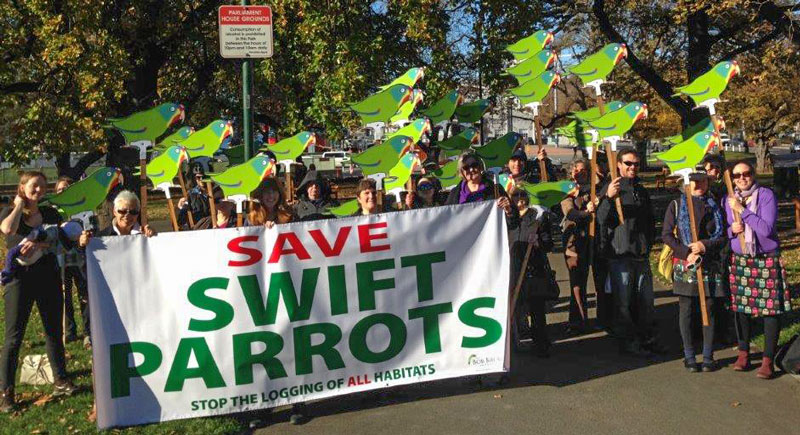
Photo: The protest on 30 May 2016
Bob Brown Foundation will host their fourth monthly peaceful demonstration on Parliament Lawns in Hobart today at 1pm, calling for ALL Swift Parrot breeding habitat to be protected.
“Each month as Parliament sits, we return for a Swift Parrot vigil, calling on the Tasmanian Government to protect all Swift Parrot breeding habitat from logging. Sadly today’s vigil coincides with the Tasmanian Government doing exactly the opposite by announcing their intention to log 400 000 hectares of moratorium high conservation value forests, including core Swift Parrot habitat on Bruny Island and Wielangta,” Bob Brown Foundation’s Campaign Manager Jenny Weber said.
“When the Swift Parrot was listed as critically endangered, among a range of recommendations made by IUCN to prevent the Swift Parrots’ extinction it included a recommendation to provide secure protection of public land that support Swift Parrots, particularly forestry land; Place all areas of public land that support Swift Parrots under secure conservation management, particularly those in timber reserves, transport corridors and local government land (i).” Jenny Weber said.
“Tasmania’s Government has a window of opportunity to back off these high conservation value forests and the habitat of critically endangered species, they could choose a future for Tasmania with a stronger economy, environment protection and jobs growth. Protecting vast tracts of native forests in secure reserves would provide many benefits to the economy, environment and climate,” Jenny Weber said.
Contact
Jenny Weber
0427 366 929
(i) BirdLife International (2016) Species factsheet: Lathamus discolor. Downloaded from http://www.birdlife.org on 13/10/2016. Recommended citation for factsheets for more than one species: BirdLife International (2016) IUCN Red List for birds.
Conservationists outraged by Hodgman move to log moratorium forests
Media Release 12 October 2016

Today, conservationists are outraged by the Tasmanian Hodgman governments announcement to log moratorium high conservation value forests.
“Logging 400,000 hectares of forests that were promised reserves under the Tasmanian Forest Agreement will push rare and endangered species closer to extinction from the rainforests of the Tarkine to the critically endangered Swift Parrot habitat of Wielangta and further entrench Tasmania’s logging shame fuelled by taxpayers money,” Bob Brown Foundation’s Campaign Manager Jenny Weber said.
“In the Tarkine more than 100,000 hectares are in these moratorium forests, rich habitat for quolls, devils and the giant freshwater crayfish. The benefits from secure long-term protection of these forests for the climate, economy and environment far outweigh the losses Tasmania feels from its unsustainable logging practices,” Jenny Weber said.
“Hodgman’s drive to log Tasmania’s unique forests is causing widespread clearfelling every day across Tasmania. Logging the 400,000 hectares of high conservation value forests across the state is at the behest of Forestry Tasmania and Ta Ann, a controversial Sarawak timber giant, and will mean further ruin for forest dependent endangered species, Tasmania’s fragile economy and any effort to mitigate climate change impacts,” Jenny Weber said.
“We will stop Hodgman's invasion of 400,000 hectares of forest reserves and endangered animals' habitat,” Bob Brown said.
For more information
Jenny Weber
0427 366 929
Public Opinion sent BP Packing - Bob Brown
Media Release 11 Oct 2016

Australian sea lions, St Francis Islands, Great Australian Bight. Photo: Bob Brown
New poll shows local opposition was 2:1.
Growing public opposition sent BP packing from the Great Australian Bight, Dr Bob Brown said today.
An opinion poll commissioned by the Bob Brown Foundation in September showed local opposition (in the conservative northwest SA electorate of Flinders) was 52% while only 27% supported the oil rig plan. 'This opposition would have been much higher in the rest of Australia - it was growing and palpable,' Brown said.
'Congratulations to the environmental campaigners and the South Australian public in particular. The Wilderness Society's campaigner in South Australia, Peter Owen, headed up a brilliant campaign which was rapidly going global,' Brown said.
'The Great Australian Bight is a national treasure of whales, seals, dolphins, seabirds and deep ocean canyons. It should now get full protection so that this threat of oil and gas rigs is permanently gone.'
ReachTEL Poll
Question 4
BP is planning to bring an oil drill into the Great Australian Bight Marine National Park south of Ceduna.
Do you support or oppose oil drilling in the Great Australian Bight?
| Total | Female | Male | 18-34 | 35-50 | 51-65 | 65+ | |
| Support | 26.8% | 24.9% | 28.7% | 16.0% | 30.5% | 32.6% | 25.7% |
| Oppose | 52.3% | 61.1% | 43.3% | 46.2% | 53.0% | 54.2% | 55.8% |
| Undecided | 20.9% | 14.0% | 28.0% | 37.8% | 16.6% | 13.2% | 18.6% |
CONTACT
Jenny Weber
0427 366 929
Prime Minister Turnbull should step in and end farce between BP & NOPSEMA – Brown
Media Release 28 September 2016

Prime Minister Turnbull should step in and end the farce between BP and NOPSEMA, Bob Brown said today.
“Mr Turnbull should tell BP not only that it hasn’t done its homework but it has failed every reasonable test and should leave the Great Australian Bight to the whales, seals and dolphins,” Brown said.
“Clearly NOPSEMA believes BP’s operation is unacceptably dangerous. That is logical enough following BP’s own astounding predictions that an oil spill would affect waters as far away as NSW,” Brown said.
“There is a rising tide of public opposition to this fraught drilling project. BP should back off and save its reputation further damage,” said Brown, who toured the Great Australian Bight aboard the Sea Shepherd’s Steve Irwin last month.
Contact
Jenny Weber 0427 366 929
Alarm over statewide planning scheme threat to national parks
Media Release 23rd September 2016

Community, science and environment voices raise alarm over statewide planning scheme threat to national parks, threatened species and urban amenity
In the lead up to the final opportunity for consultation on the proposed State Planning Provisions, a growing range of community voices are coming together to highlight key concerns with the direction of the changes and the alienation of the public in planning decisions. Next week the Tasmanian Planning Commission will hold hearings on aspects of the scheme.
The proposed State Planning Provisions, a key component of the Tasmanian Planning Scheme, remove both environmental and community protections and the capacity for public engagement in planning decisions. It amounts to gifting the real estate and tourism development sectors a similar 'special deal' that was granted to aquaculture 20 years ago and forestry and mining industries before that.
The Tasmanian Planning Scheme is the most significant legislative change to planning law since the introduction of the Resource Management and Planning System in 1993 and unfortunately it counters many of the objectives that system was designed to implement.
Planning Minister Peter Gutwein is expected to sign off on the new State Planning Provisions in December and strong protections and public involvement provisions must be retained. These are historic changes that most Tasmanians have no idea about.
"Tasmanians have traditionally been wary of politicians that get too close to big business. We need to know that our government isn't just box ticking development plans for the big end of town, while locking locals out of the process that should give them a say about what happens in their own backyard," said Laura Kelly, Strategic Director for Environment Tasmania.”
Distinguished Professor Jamie Kirkpatrick has studied the natural values of Tasmania’s parks and reserves for 40 years and said “a planning process simply shouldn’t allow development in Tasmania’s conservation reserve estate to be exempt from rigorous and transparent assessment as it will lead to an inevitable deterioration of the natural and cultural values the reserves are designed to protect. The public service is simply not adequately resourced to carry out community-based planning.”
Sophie Underwood recently spearheaded a campaign with RACT members regarding expanded tourism development in Freycinet National Park. She said the response to that proposal demonstrated how valued national parks are, and how critical it is that the community has a say in the way that parks and reserves are managed. “If the Tasmanian Planning Scheme is introduced, the community will lose the ability to properly scrutinise future proposals by a proponent like the RACT, opportunity for public comment will be limited and the right of appeal will be taken away.”
“The iconic natural and scenic beauty of the East Coast is being threatened via changes to planning laws that put developers interests ahead of the public interest and sound and democratic planning processes,” said Todd Dudley, President of the North East Bioregional Network.
Nick Sawyer is spokesperson for the Tasmanian National Parks Association and worked in reserve management for the Parks and Wildlife service for many years. He said “opportunities for public scrutiny of proposed developments within national parks are already inadequate and full introduction of the new Tasmanian Planning Scheme will only make the situation worse. Changes are urgently required to guarantee both public comment and appeal rights.”
Concerns with the proposed new planning scheme extend to non-reserved land, including private land that is known to hold important natural or community amenity values. The Tasmanian Conservation Trust has worked on private land conservation issues for decades and noted a disturbing weakening of protections in the new planning scheme.
"The government has failed to ensure that threatened species habitats will be protected with appropriate zoning on private land so it seems that wherever industry has an interest, habitats will get second priority," said Trust Director Peter McGlone. “Planning schemes should provide a safety net for species, prohibiting development in critical habitat areas, but this scheme is a net with so many gaping holes it is hard to see how threatened species will be saved by anyone other than enlightened proponents.”
Robert Vincent is an Architect with urban and regional planning experience and is spokesperson for the Tasmanian Planning Information Network (TasPIN). Mr Vincent said “These planning changes are complex and detailed and will have far-reaching ramifications for people and places across Tasmania. They are being imposed with little explanation but will serious consequences for our urban amenity.”
For comment:
Distinguished Professor Jamie Kirkpatrick – 0499 879 514
Todd Dudley – NEBN - 0448 009 738
Robert Vincent – Tas PIN – 0478 050 843
Peter McGlone – Tasmanian Conservation Trust – 0406 380 545
Sophie Underwood – Freycinet Action Network – 0407 501 999
Nick Sawyer – Tasmanian National Parks Association – 0414 718 831

John Mulvaney reshaped Australia - Bob Brown
Media Release 22 September 2016

Professor John Mulvaney was a unique historian and archaeologist who gave Australia a new, more truthful insight into its ancient human history and who helped save some of the most remarkable places in the nation, Bob Brown said in Tasmania today.
"He brought a new truth to ancient history and was also eager to save the beauty of the nation, from its Franklin River gorge country in Tasmania to mature European trees facing demolition to make way for the National Museum in Canberra.
"John Mulvaney brought much-needed gravitas and authority to the campaign to save from logging Tasmania's Recherche Bay peninsula where French scientists and the Palawa people met up in 1793. He weighed into saving the Franklin River in Tasmania and the Daintree rainforest in northern Queensland, and was ready to bring his globally-celebrated scientific knowledge to bear in many other environmental campaigns," Brown said.
"In unfinished business, John wanted the million Aboriginal stone carvings on Western Australia's Burrup Peninsula near Karratha - one of the world's greatest ancient art sites - protected from the expansions of the offshore gas processing industry and given the World Heritage status they deserve. This was opposed by Premier Colin Barnett.
"John Mulvaney was a warm-hearted, generous and inordinately wise Australian," Brown said.
Contact
Jenny Weber
0427 366 929